
By Penny Nakamura
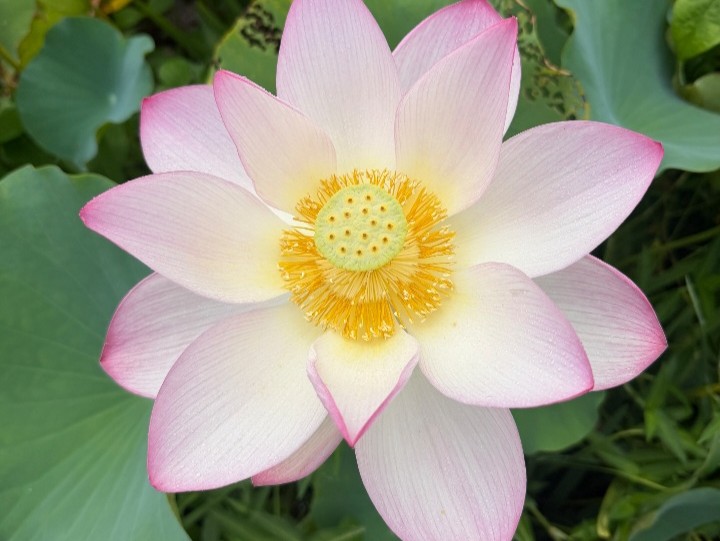
Though George Tanabe worried his Waialua acre of Chinese pink lotus flowers would be destroyed by the muck and mud of the Kona Low storms, he stood on the shores of his large spring fed lotus pond and smiled at the irony on a recent sunny summer day. “You can see where the mud flowed, by the high marks on the trunk of these coconut trees, this whole pond was several feet under water,” said Tanabe, a retired University of Hawaii religion professor and author. “But it turned out, we had more pink lotus flowers, than I’ve ever seen; it was really a bumper crop.” The Chinese lotus, an aquatic perennial plant with its large fragrant bowl shaped pink flowers towered over the pond water with its eight- to twelve-inch-wide blossoms. The round shaped hydrophobic leaves, also rise above the water.
It is a true visual feast for the eyes. “There’s a lesson in this: In Buddhism, we believe something beautiful can come up from the muck and mud,” said Tanabe surveying his pond full of lush pink lotus flowers. “When you see pictures or statues of Buddha, he’s sitting on a lotus.” Tanabe explains the “lotus effect” pointing to the round broad leaves of the lotus, which can repel water into water droplets that roll off the plant taking with it dust, dirt and bugs, in a natural selfcleaning method. The lotus symbolizes: divine purity and spiritual awakening and rebirth.
As for “lotus eaters”, Tanabe says every part of this rhizome plant, known as hasu in Japanese, is edible, and it’s supposed to have a calming effect on the mind.
“People always complain that it’s so expensive to buy hasu, but it’s so much work to harvest lotus root, I know because when I was a youngster, we used to have to harvest it,” said Tanabe laughing. “You’re knee high in mud, and you take this large, long root out of the water for harvesting, but you have to leave the suckers in the mud for the next year’s harvest, it’s back breaking labor.” Tanabe tells the story of how he grew up with lotus.
“My grandfather immigrated here from Japan in 1898 worked on the sugar plantations and knew enough English that they made him the first Japanese luna (foreman) on the North Shore. But in 1914 the workers had a dispute, so instead of betraying his friends, he quit the plantation leased some land here and started planting lotus,” said Tanabe. Several acres of lotus were planted. Tanabe says it originally extended from his current lotus farm all the way to Waialua Beach Road.
At the lotus farm, Tanabe has built a wooden boardwalk that allows visitors to stroll through the lotus patch to his hand built Japanese Tea house at the far end of the pond. Along the stroll, Tanabe uses the analogy of the strength of the lotus to endure and spread beauty.
“This is a true story: a Japanese paleobotanist; Ichiro Oga in 1951 found a lotus seed that was carbon dated to be two-thousand years old, he scored it, and that seed grew to be a new lotus plant,” said Tanabe. “Now they grow this Oga lotus all over Japan. I tried to grow it in my pond here, but unfortunately it didn’t take.”
Farther along the boardwalk, Tanabe plucks a stalk of a lotus plant and breaks it in half, to show a long fiber that emanates from the stalk halves and he starts twisting it. “If you twist this long enough, it’s a very strong thread, in Southeast Asia they make threads out of this to make a cloth,” said Tanabe, who still marvels at the overall utility of the lotus plant. “ In Japan there’s a very famous tapestry that’s made of this lotus thread.”
Though the Kona-Low storms destroyed so much on the North Shore, Tanabe can still see strength and beauty that has come from the mud and the muck, not just from his lotus blossoms, but also how neighbors showed up for one another, and continue to show up in the aftermath of the additional tropical storms, hurricanes and flooding that have been pummeling the islands.