
By Boyd Ready
Waialua Agricultural Company in 1900-1902, while clearing and planting thousands of acres, excavating water tunnels, and building the new dam at Lihue Pali (near Wahiawa), had labor problems. As a new territory of the United States, the anti-slavery 13th Amendment applied, and the several thousand Japanese and other laborers soon learned the ‘master-servant’ law in force when they were recruited, making quitting a crime, was not enforceable. Wildcat strikes slowed progress. In nearby Kahuku newspapers recount lunas on horseback using ‘bullwhips’ to drive rioting laborers back to their camps.
Waialua’s manager, seeking options, had already found a shipping agent in Korea to negotiate for groups of Korean laborers to come to Waialua. On the morning of January 13, 1903, the SS Gaelic steamed into Honolulu Harbor carrying the first organized group of Korean immigrants ever to come to Hawaii. Aboard were 102 people—roughly 56 men, 21 women, and 25 children—who had left Incheon and stopped at Nagasakien route. Many were members of the Nai-Ri Methodist Church in Incheon. Their pastor, the American Methodist missionary Rev. George Heber Jones, had encouraged them to go, assuring them of better wages, free housing, and medical care. Half the passengers were Methodist
Christians; several more joined through shipboard services. Arriving by train at Waialua they received hastily built houses near Otake camp. Before long, the new camp flooded so it was moved to higher ground mauka of St Michael’s church.
The first arrivals and the next boatload (sent to Kahuku) began worshiping together, establishing the Kahuku-Waialua Korean Mission. But the immediate challenges were daunting. In 1904 about 1500 Japanese workers went on strike. Among 32 demands from the minutes of the negotiations with Mr. Goodale was that he provide their own ‘water closets’ in Mokuleia camp so they would not have to share the facilities with Koreans. In the longer, 1909 Japanese laborers’ strike, the Koreans, Portuguese, Puerto Rican and Hawaiians were paid double wages, $1.50 per day (about $45 in today’s dollar), to defeat the strike. To make matters worse, in 1910 Japan’s annexation of Korea created Korean resentment. So, with picture brides and families arriving, and mutual bad feelings (Koreans (only 8% of Waialua’s workforce) began leaving for jobs or to start trades or businesses in Honolulu. Not all left, resentments faded, and in the 1920 Japanese strike many Koreans joined, making it more effective.
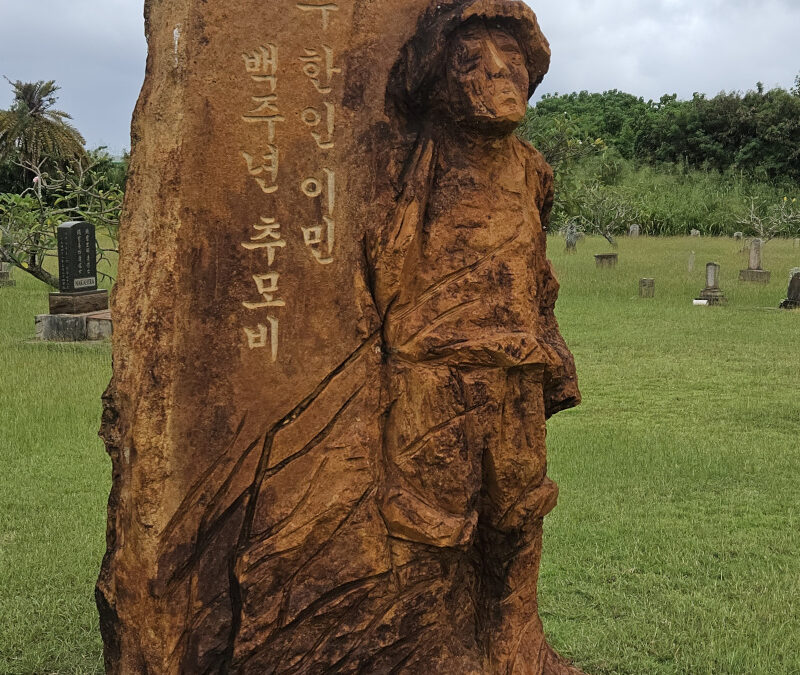
Each January the early Korean presence at Waialua is remembered at Puʻuiki Cemetery, the final resting place of many workers, their wives and children. In 2003, for the centennial of the Gaelic’s arrival, Korean artist Bou Chan Park installed a commemorative sculpture among the graves. The Korean American Foundation Hawaii and community volunteers now annually place up to 1,500 leis on the headstones at Puʻuiki and at Oʻahu Cemetery. The sculpture and the next lei-placing event, planned for January 11, 2027, commemorate Hawaii’s first Korean workers who settled in Waialua.
For more information www.waialuahistoricalsociety.org